
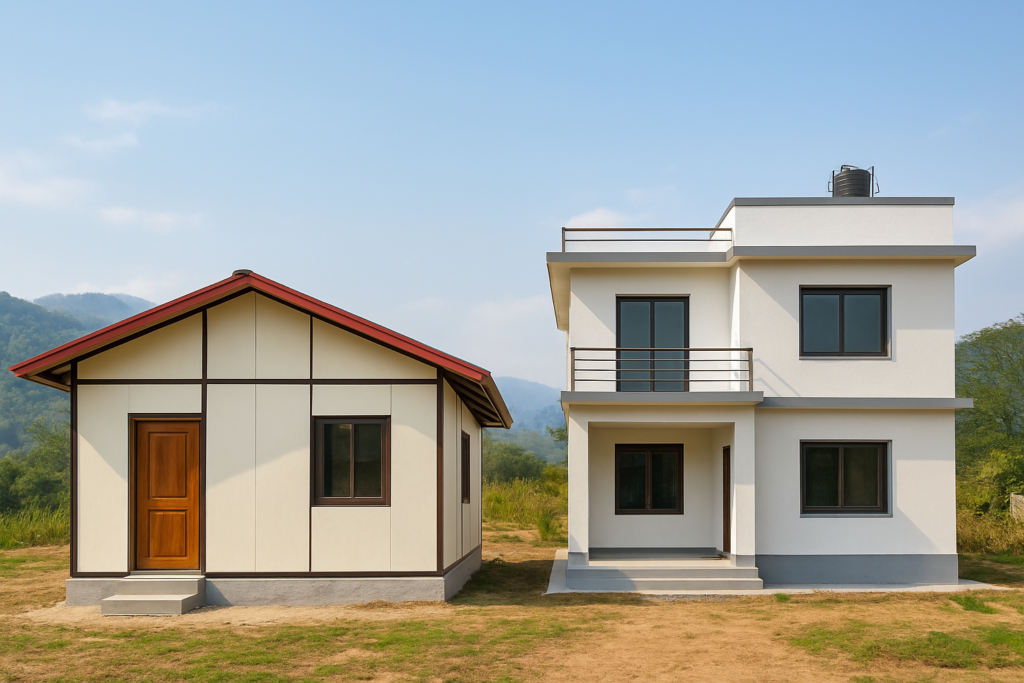
Last updated: 27 June 2026. This comparison was refreshed with clearer 2026 cost factors, construction speed, structural considerations, practical use cases and links to related AS Design resources.
SY panel house vs RCC house is becoming a common comparison in Nepal, especially for homeowners looking for faster construction, lighter wall systems, better insulation and lower long-term maintenance. As a civil engineer, I would not say one system is always better. The right choice depends on land, budget, structural design, number of floors, local workmanship and how the building will be used.
This 2026 guide compares SY panel and RCC construction in Nepal based on cost, speed, strength, earthquake performance, insulation, durability and best use cases. For general construction budgeting, also check AS Design’s construction cost calculator Nepal and construction cost per sq ft guide.
Quick Comparison: SY Panel vs RCC House
| Factor | SY panel house | RCC house |
|---|---|---|
| Construction speed | Usually faster if team is experienced | Slower due to RCC cycles, brickwork and curing |
| Weight | Lighter wall system | Heavier structure and masonry |
| Structural familiarity | Needs trained installer and proper detailing | Very common in Nepal |
| Design flexibility | Good, but depends on system limits | High flexibility with proper design |
| Earthquake performance | Can perform well when engineered properly | Can perform well when designed and built properly |
| Workmanship availability | Limited compared to RCC | Widely available |
| Best use | Fast builds, light walls, specific modern projects | Most residential and rental buildings |
Cost Difference in Nepal
SY panel cost depends on panel type, thickness, reinforcement/detailing, transport, plaster/finishing system and installer experience. RCC cost depends on cement, steel, sand, aggregate, brick/block, labour and finishing level. For small and simple projects, SY panel may save time; for conventional multi-storey rental houses, RCC is still easier to plan because local contractors are familiar with it.
Do not compare only wall material rate. Compare the full system: structure, wall, plaster, labour, transport, finishing, waterproofing, electrical/plumbing routing and future maintenance.
When SY Panel Makes Sense
- You need faster construction with trained installers.
- The project benefits from lighter wall systems.
- The design is planned around panel dimensions and detailing.
- You want better thermal/acoustic performance compared to basic masonry.
- You have proper engineering review and execution supervision.
When RCC is Safer Practically
- You are building a typical 2.5 or 3.5 storey residential/rental house.
- Your local contractor team is experienced with RCC.
- You need more design flexibility for future changes.
- You want easier availability of labour and materials.
- The municipality/approval team is more familiar with conventional drawings.
Common Mistakes
- Choosing SY panel only because it sounds modern.
- Choosing RCC only because everyone else uses it.
- Ignoring structural design and detailing.
- Comparing only material rate instead of full finished cost.
- Using untrained labour for unfamiliar systems.
- Not planning electrical and plumbing routes early.
Helpful resources: house construction in Nepal, free BOQ template, and house design in Nepal with price.
My Civil Engineer Recommendation
For most Nepali homeowners, RCC is still the safer default because materials, labour and supervision are widely available. SY panel can be a good option for selected projects where speed, lightweight construction and trained execution are available. The best decision should be made after comparing full system cost, design requirements and local workmanship—not just marketing claims.